Centrifuge
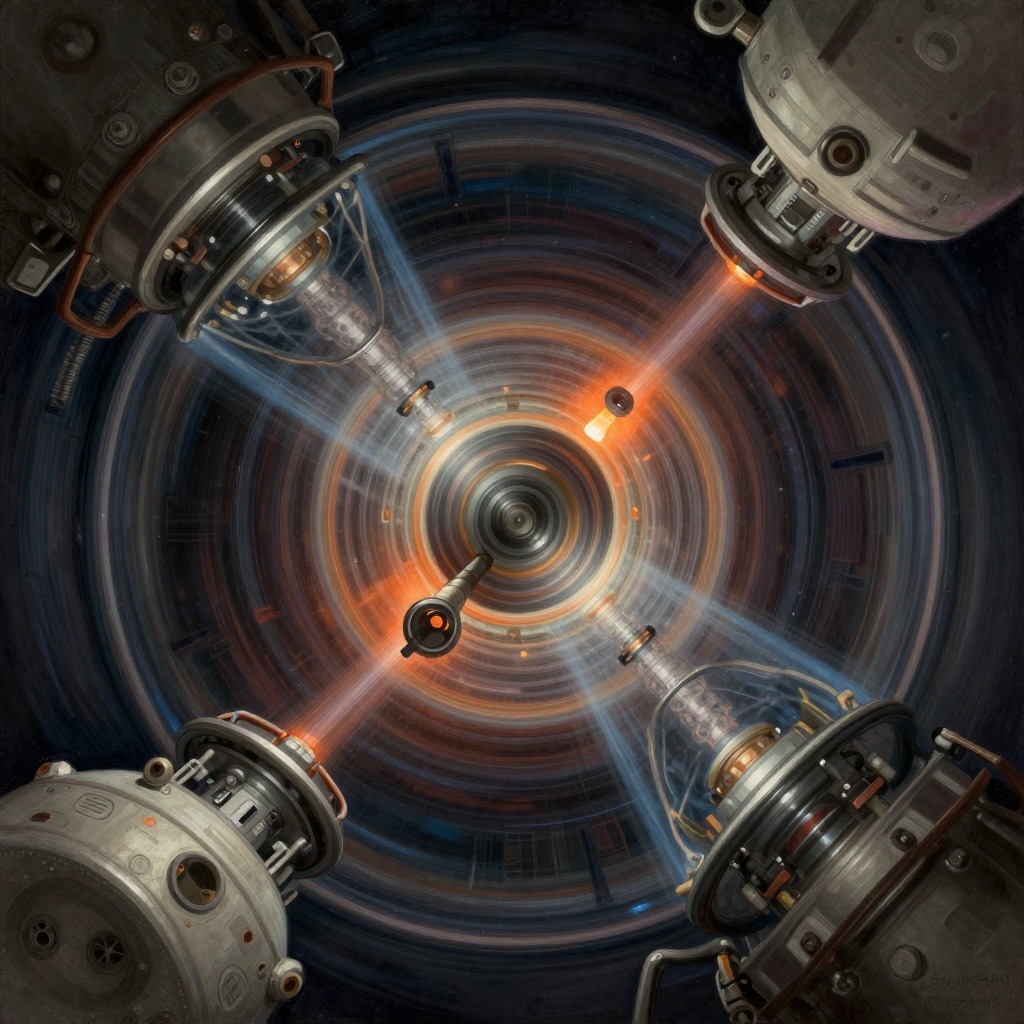
The Hail Mary's centrifuge is the ship's artificial gravity system, a critical engineering solution that enables the crew to conduct scientific experiments in a familiar gravitational environment during the long interstellar voyage. Without it, the mission's laboratory equipment—designed and perfected over decades of use on Earth—would fail in zero gravity, rendering the entire Tau Ceti expedition pointless. The centrifuge was not part of the original design; it was proposed by Dr. Lokken, a Norwegian scientist who forced a meeting with Eva Stratt to argue that the ship's lab equipment, from electron microscopes to gas chromatographs, could not be reliably adapted for weightlessness within the available time. Stratt initially resisted, citing the added complexity and risk, but Lokken's detailed diagrams and Grace's support convinced her to adopt the system.
Design and Mechanism
The centrifuge works by splitting the Hail Mary into two halves: the forward crew compartment and the aft section containing the fuel tanks and spin drives. These halves are connected by spools of Zylon cabling that can extend up to 104 meters. When activated, the crew compartment rotates 180 degrees so its nose points inward toward the rear half, and the entire assembly spins to generate centrifugal force. The system is controlled from a dedicated Centrifuge screen in the control room, which displays yaw, pitch, and roll rates, crew compartment angle, spool status, and estimated gravity at the lab floor. The computer manages the entire sequence automatically, including the gradual separation of the two halves and the rotation of the crew compartment, to minimize shock to the ship and crew. Grace first discovers the centrifuge's existence when he remembers Dr. Lokken's presentation during a flashback, and he later finds the control panel hidden as a subpanel within the Life Support screen.
Operation and Risks
Grace activates the centrifuge for the first time after the Hail Mary reaches Tau Ceti and the main engines cut off. The sequence begins with an alert chime, then the ship starts to spin slowly. As the crew compartment rotates, Grace experiences disorienting forces—the room seems to tilt, and he drifts toward the navigation panel before strapping himself into the pilot's seat. The transition is smooth, and within five minutes the system reaches a stable 1.00 g of gravity at the lab floor, with a pitch rate of 20.71 degrees per second and a total separation of 104 meters. The centrifuge must be spun down whenever the ship needs to use its main engines, because firing the spin drives while the ship is in two pieces connected by cables would be catastrophic. During the crisis at Adrian, when the fuel tanks rupture and the ship begins to spin uncontrollably, Grace uses the centrifuge's manual controls to extend the cables to their maximum length, reducing the centrifugal force from lethal levels to a manageable half-gravity, which saves his life.
Narrative Significance
The centrifuge embodies the tension between innovation and reliability that defines the Hail Mary project. Stratt's initial reluctance to add moving parts reflects her philosophy of minimizing points of failure, but Lokken's argument—that proven, off-the-shelf equipment is more reliable than hastily developed zero-g versions—ultimately prevails. The centrifuge also becomes a recurring operational constraint: Grace must repeatedly spin it up and down for EVAs, engine burns, and the docking with Rocky's ship, each time risking the structural integrity of the cables and the crew compartment's rotation mechanism. Its presence transforms the Hail Mary from a simple rocket into a dual-mode vessel, capable of both high-thrust acceleration and stable laboratory conditions, and its successful operation is a testament to the engineering that made the mission possible.